
Vijay Prashad
Fuente de la fotografía: Albinfo – CC POR 4.0
Los disturbios otoñales en Europa no comenzaron bajo las cámaras de televisión en París. Antes de que los estudiantes bloquearan las escuelas en Francia continental, los profesores y padres de Mayotte (un territorio francés en el Océano Índico) y los estudiantes de la Guayana Francesa (un territorio francés en América del Sur) ya habían exigido las condiciones elementales de una educación. Sus protestas recibieron poca atención, ya que la geografía del reconocimiento sigue un antiguo mapa colonial. Cuando la misma ira llegó a la capital francesa y sus suburbios, se convirtió en una crisis nacional. Desde allí, imágenes de marchas, ocupaciones escolares y enfrentamientos viajaron por un continente donde millones de personas reconocen la misma situación: todo lo necesario para la vida se vuelve más caro, mientras que las instituciones destinadas a sostener la vida se debilitan constantemente.
No hay un levantamiento europeo único, con una organización o un programa acordado, pero sí se desarrolla una ira y una frustración inquietas. En Albania comenzó la disputa por la venta de tierras costeras, en Alemania la discusión es sobre un posible servicio militar obligatorio para una guerra sin sentido, y luego en Portugal y España la cuestión era la vivienda. Sin embargo, se repiten cuatro agravios: la erosión de la provisión social junto con el enriquecimiento en la cima, la represión policial de la disidencia, las restricciones a la solidaridad con Palestina y el desvío de energía política y recursos públicos hacia la guerra. Estos agravios se encuentran cada vez más en las calles. Lo que los conecta es una crisis de confianza en los gobiernos que exigen sacrificios mientras aíslan la riqueza y el gasto militar del escrutinio popular.
The 31st Fructidor of Emmanuel Macron
Mayotte and French Guiana sounded the alarm first. At Mayotte’s Cité du Nord school, mobilisation began on 31 August. Roughly 2,300 pupils are accommodated in school buildings designed for 900. In Cayenne, French Guiana, students at the Félix-Éboué school presented seventeen demands on 7 September, including ventilation, decent sanitation, and an affordable, functioning canteen. The French media does not always document these protests, so far away, and yet technically in France, but they start with the protests at Saint-Exupéry in Créteil when pupils and parents protested a lack of teachers. The overseas protests expose inequalities within the French state that disappear when France is described through national averages. It was because of the protests that the inequality became tangible rather than statistical – in Mamoudzou (Mayotte), on 29 September, pupils spoke of such unbelievable things as hunger, insecure journeys to school, and insufficient facilities. Trade unions in Mayotte demanded that social rights on these islands of 320,000 people be brought in line with those of the entire French nation. What was presented by the students as a local problem contained an indictment of French imperialism. The promise of equal citizenship had not produced equal conditions of life.
On the mainland, the spread of school blockades brought familiar grievances into sharper focus: unfilled teaching posts, overcrowded timetables, deteriorating buildings, and anxiety about access to university. By 29 September, Le Monde reported disruption at 180 establishments. The school gate became a gathering place for a generation instructed to compete for a future whose foundations were being dismantled. Parents and teachers could recognise their own exhaustion in these demands. Public education was revealing what austerity means in practice: the transfer of responsibility from collective institutions to households, and within households to those least able to purchase a private alternative.
France’s movement carries the accumulated experience of earlier confrontations. The Yellow Vests (Gilets Jaunes) of 2018 made visible the costs imposed on working people whose lives depended on cars and whose wages could not absorb another petrol increase. Battles over pensions raised the question of who should bear the cost of longer working lives if retirement ages are raised. The present students inherit that argument about the distribution of sacrifice, but their mobilisation also supplies a different emphasis. Before they can fight over retirement, they must fight for teachers, meals, and classrooms. The social contract is being contested at both ends of a working life, and throughout the years between them. French President Emmanuel and Brigitte Macron were too busy dancing at a Céline Dion concert in Nanterre to be bothered with the burning streets.
Go Live in a Tent
Belgium, Spain, and Portugal widen the picture. Belgian demonstrations have joined anger over austerity to unrest in education. Spanish housing encampments and Portuguese marches insist that a wage is insufficient protection when rent absorbs the means of living. These are struggles over the social wage: the housing, transport, education, and healthcare that determine what an income can buy. A nominal pay rise cannot compensate indefinitely for their deterioration. The household budget and the public budget meet in the same place. When governments reduce collective provision, families pay again through fees, rents, debt, and unpaid labour.
The class content of capitalist life is made absolutely clear in the arena of housing. For a tenant, an apartment is a means to live, while for an investment fund, it is a stream of revenue. The clash between the two is the frontline of the class struggle. Government policies that increase the value of property assist the investment funds, but they then deepen the insecurity of the tenants. The same fundamental contradictions of class warfare run through tourism development, where public authorities advertise prosperity while residents face displacement and declined access to their neighbourhoods. Airbnb becomes the face of housing, pushing older residents further and further from the tourist-heavy city centre. Europe’s housing protests challenge the economic model that relies on asset values and that relies upon tourism, rather than the economic model that builds a productive economy for the people themselves.
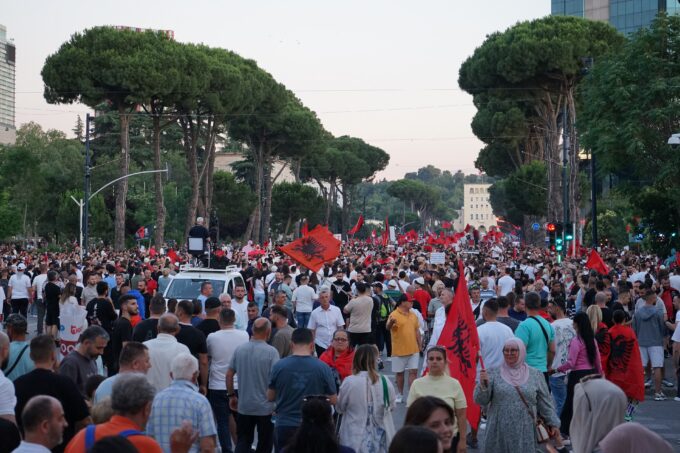
Albania’s Flamingo Movement
In Albania, this class contradiction has been defined by a flamingo. Demonstrations against luxury developments associated with Jared Kushner and Ivanka Trump began in late May and grew into a wider challenge to Prime Minister Edi Rama. Projects around the Vjosa-Narta protected area and Sazan Island brought together environmental objections, disputed property claims, and anger about government accountability. Residents confronted fences on land that they claimed, followed by clashes with private security forces. The flamingo, a threatened inhabitant of the wetland, became a symbol through which people defended their own place in the country’s future. Albania’s national bird is the golden eagle, but if these protests succeed, the country might have to swap it with the flamingo.
The Albanian government argued that major investors, such as Kushner and Trump, will transform tourism and create opportunities, but protestors ask why such transformation should endanger protected landscapes and proceed through contested arrangements. Their anger is sharpened along the axis of class as they compare these luxury projects to inadequate everyday services, including public housing. Land that is the common inheritance is being given away to people like Kushner-Trump without payment, which makes this no longer about development but about corruption and ecological survival.
Rama, who comes from an artistic and political family, has been in power since 2013, but miscalculated the public mood this time. In late October, he announced that there would be substantial fines for people who remained in crowds where violence or looting occurs, even if they themselves do not do any of those things. Such collective exposure is intended not to protect property, but to intimidate those who would otherwise want to be part of the peaceful protests. Albania, like every other European country, treats anger over austerity as a security problem rather than an opportunity for democratic dialogue. A protest that began around investors seizing land has now been transformed into a debate about the treatment of ordinary citizens.
GL-304
On 5 October, the police near a protest at a school in Lens (France) threw a GL-304 stun grenade, which exploded near some students. One student, age 15, lost his hand in the blast. Two days later, France’s interior minister Laurent Nuñez announced the temporary suspension of the weapon during school demonstrations. The education minister Édouard Geffray announced that planned job cuts would be suspended. There was money in the state’s budget to deploy heavily armed police to the school, but no money to hire new teachers to fill in the already depleted ranks. This was the decision of the state, and this gave parents and pupils further reason to distrust its institutions.
Distrust leads to anger, which can germinate into hate. People took to the streets to meet the police violence with violence, which meant attacks on shops and looting, s well as the burning of barricades. They do not define the totality of the protests, but they are an accurate measure of the feelings of a large number of people. The government used images of the destruction to try and displace discussion about their own policies, but however many broken windows they showed, the popular mood focused on the lack of desks and teachers in classrooms. An inventory of damage has not fully prevented the examination of its social setting, namely the austerity wasteland of working-class France.
Bedarfswehrpflicht in Germany
The German government, caught in its own hype about the Ukraine war, has begun to consider the use of conscription to draw in its youth to the military. Laws have been passed that ensure that if there is a shortfall in troops, then the government can trigger an emergency conscription (Bedarfswehrpflicht). This is deeply unpopular amongst the youth, who are frustrated like their European peers with lack of investment in education, lack of relief for rising living costs, and hostility by their government for a climate agenda and for an end to the genocide in Palestine. On 31 October, thousands of people – under the initiative of Gen Z regelt (Gen Z takes charge!) – gathered at Berlin’s Brandenburg Gate. Their message was peaceful and simple: more investment in people and less in war. The previous day in Italy, USB, an Italian trade union mobilised workers for a general strike against the war economy and inflation, connecting wages and pensions to spending on weapons. Dockworkers blocked parts of Genoa’s port. NATO foreign policy took on a material form at the docks: ships and their cargo linked decisions about war and the daily organisation of production. Warfare has entered daily life through the ugliness of inflation for necessities.
NATO’s Hague Declaration (2025) committed the member states of this military alliance to a target of 5% of GDP toward military spending by 2035, making a powerful claim on scarce public resources. The European Union, which had been strict about fiscal rules, has suddenly become flexible for increased military expenditure. Germany’s parliament lifted a debt brake for the military. The political choices are straightforward – when it comes to the military industries, prudence is unnecessary; austerity is only required against the working-class and the working-class is crushed when it tries to lift its voice into the debate about these kinds of choices.
Young people across Europe are being told to shoulder two responsibilities: to work hard in precarious employment with expensive housing so that they can take care of the pension claims of their grandparents and parents, and to prepare themselves for military conscription for wars that they do not understand and do not want.
Viva Palestine
Across Europe, at the protests, the issue of Palestine has a shadowy presence. From the start of Israel’s genocidal war in October 2023, governments across Europe effectively banned protests for Palestine. In France, the Interior Minister Gérald Darmanin’s October 2023 instructions called for prohibitions on pro-Palestinian demonstrations. A few days later, the Conseil d’État clarified that such a blanket prohibition was not legal, but that prefects in different parts of the country had to assess the circumstances one-by-one. In fact, since then, the prefects have largely followed the instruction from Darmanin and banned demonstrations, with the idea being that solidarity with Palestinians comes with a presumption of danger, making the defence of Palestinian lives inseparable from the defence of freedom of assembly.
The pressure continued beyond that first confrontation, since by 2025 human rights organisations had begun to document disproportionate restrictions on Palestinian solidarity, not just in France but in Germany and in other European countries. Between banned events, even on university campuses, and police violence came the deportations or denial of entry to foreign participants for events. These experiences created a bitter lesson: European governments could speak about universal rights (such as, for instance for Ukrainians) while restricting those demanding that the same rights apply to Palestinians. Protesters carried that experience into subsequent struggles over education, racism, public spending, and the conduct of the police. Shared encounters with police lines, disciplinary proceedings, and official denunciation widened political understanding. Young people, in particular, questioned why democratic participation is tolerated only while it remains inconsequential and why action for Palestine is banned.
Organización
Estos movimientos enfrentan preguntas difíciles sobre organización y dirección. La ira por sí sola no puede determinar si el resultado será una mayor provisión pública, represión o ganancias para la extrema derecha de un tipo especial. Esto último puede redirigir la inseguridad hacia los migrantes y al mismo tiempo dejar intacta la propiedad concentrada. Una alternativa duradera requiere vínculos entre estudiantes, inquilinos, trabajadores y los movimientos por la paz y la libertad palestina. Su punto en común radica en la exigencia de que la riqueza sustente la vida humana y que los derechos democráticos protejan la lucha para asegurarla. En toda Europa, la gente pide escuelas en las que puedan aprender, hogares que puedan permitirse y un futuro más allá de la guerra. Que estas demandas adquieran fuerza política duradera dependerá de un trabajo paciente más allá del espectacular día de protesta, a través de asambleas, sindicatos y organizaciones vecinales capaces de convertir el daño compartido en un programa y la fuerza para ganar. Las elecciones son un encuentro con el poder, que se pondrá a prueba en las elecciones presidenciales francesas. Pero más allá de eso está el ámbito de la opinión pública, que cada vez se aleja más del establishment y se acerca a otras consideraciones…… en las calles de París, cantan elInternacional.
Vijay Prashad es el director de Tricontinental: Instituto de Investigación Social. Su libro más reciente (con Grieve Chelwa) es Cómo el Fondo Monetario Internacional asfixia a África (de Inkani Books).
Fuente: CounterPunch