
Robert Hunziker
y máquinas.
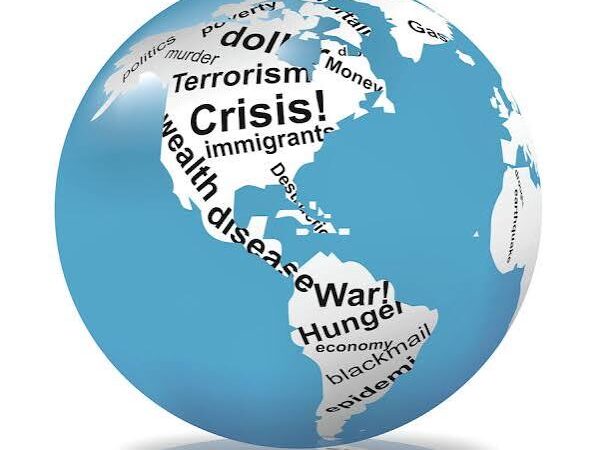
Las encuestas estadounidenses muestran niveles récord de angustia, miedo y profunda preocupación por el presente y el futuro de Estados Unidos. Esto plantea la pregunta de si el colapso del orden mundial es la raíz de estos altos niveles de preocupación.
A Encuesta de CNN Afirma que el 67% de los adultos estadounidenses se sienten asustados o profundamente pesimistas sobre el futuro del país.
A Investigación Pew La encuesta del Centro dice que el 59% de los estadounidenses cree que los mejores años del país quedaron atrás.
El Asociación Estadounidense de Psiquiatría Afirma que una “crisis de ansiedad” está muy extendida entre los adultos estadounidenses.
“El orden global se está desmoronando, impulsado por centros de poder cambiantes, disrupción tecnológica y creciente rivalidad entre naciones.” (El orden global se está desmoronando, pero ¿qué viene después? Escuela de Servicio Exterior, Universidad de Georgetown, 8 septembrie 2026)
Una entrevista reciente con Margaret Olwen MacMillan, profesora emérita de la Universidad de Oxford, ex rector del Trinity College y reconocida experta en la historia de las relaciones internacionales, ofrece una perspectiva única sobre la trascendental cuestión del colapso del orden mundial: Margaret MacMillan advierte: El orden mundial se está derrumbando _ y lo que viene es mucho peor, Podcast de decodificación de geopolítica con Dominik Presi, YouTube, 10 de noviembre de 2026.
The following is a summation of the Margaret Olwen MacMillan interview, including editorial commentary:
The world is at a very, very strange place. Several notable people have adopted, or coined, a new word ‘Polycrisis’ meaning too many things happening all at once. The various crises are beginning to affect one another. For example, the climate crisis affects migrations of thousands of people and severely affects the capacity to support life via agriculture. Meanwhile, rivalry among various disparate viewpoints affects how climate change is dealt with, leading to weakened policymaking.
Essentially, people throughout the world are overwhelmed by what’s going on with strange changes happening right under their noses. Over the past seven decades the United States has been a measured pillar of the international system, but now, under the present administration, doing its best to disrupt that status, if not destroy it entirely. And guess who’s coming to dinner, there’s an odd friendship ongoing between the United States and Russia, unprecedented, unexpected, and shocking to many!
Indeed, big question marks overhang this epic take down of world order. It’s new to the 21st century led around by the nose by oddball participants, like AI as the biggest potential existential crisis of the century. What it means going forward remains the mystery of all mysteries… Oops! what if it fails to produce enough to cover billions upon billions on top of billions (emphysematous debt) in which case it’s epitaph shall read the blind leading the blind down the biggest rabbit hole of all time? And further confronting existential threats, what does climate change mean for society going forward? These world-impact incidents are sources of a great unknown that serve to stoke anxiety and undercut normalized viewpoints. It’s difficult for anyone, cast in the midst, to fully understand changes today that history often judges differently.
“My own view is that they are changing, and it is one of those moments like the end of a major World War.” (MacMillan)
Storm Signals
Before storms hit, the atmosphere feels different, it changes quickly, just before it rolls in; animals sense this ahead of time. Similarly, socio/economic/politico storms send early tipoffs. For example, in Trump’s first term, people assumed: “This is just a blip… America’s democracy will survive… he’s a bit excitable… he sort of exaggerates things… but basically the structures were fine.”
Surprise/Surprise Politics takes an interest in “All of Us”
Whereas, in this 2nd term “we are beginning to question all of that 1st term.” Certain things stand out (1) undermining authority of Congress (2) the weird role of the Supreme Court (3) the attack on State’s Rights. These are things that may be more lasting than anybody expects. Daily, most people tend to brush off these signals and get on with their everyday life. But “Politics is Taking an Interest in us.” This new dynamic of “politics taking an interest in us” has not been seen throughout America’s spirited principles of a democratic republic. It’s new, it’s brand new, but not all that mysterious.
As for a storm on the horizon, an analogy is found in pre-WWI. A lot of people in the 1930s thought there would be another war on the heels of WWI, and countries prepared with additional defense spending; people expected it. In contrast to that line of thinking, pre-WWI was serene, a society that had moved beyond the conflicts of the prior century. At the time, people thought they were more sophisticated, more civilized, and not concerned about more wars, society felt it had moved beyond the brutality of 19th century warfare when America, for one, was nearly taken down to its knees in a brutal, bloody civil war.
Back then, in a casual manner, during the summer of 1914 people took off for their family holiday get-togethers. But suddenly the war started June/July 1914, surprising everybody. Vacationers felt compelled to rush back home from family holiday fun, as fear overtook celebration. Today is quite similar to that period before the 1914 catastrophe that shook the world down to its knees.
Today, there are several warning signs of impending trouble that are largely ignored, like pre-1914. For one, warfare has clearly changed, e.g., new technology, the arrival of drones is an obvious change. We’re increasingly seeing the “automated battlefield” that can easily go astray. Soldiers in such a battlefield zone are very dangerously exposed and likely to be killed. Insidiously, increasingly we see use of AI, artificial intelligence. This is a new keystone in warfare as well as a device of personal concern everywhere by everybody.
Various levels of warfare are found throughout the world; numerous state-in-state wars are underway even though most people believe this type of warfare is basically obsolete. Civil war, insurgency, terrorism is found throughout the world. Indeed, there are plenty of prospects for more civil war. Alas, there are at least a dozen, if not more, actively ongoing today. Indeed, more prospects of increased divisions within countries result in civil wars, like in Sudan, like in Congo, like in Burma. This is an ever-increasing danger throughout the world.
And with the Russian invasion of Ukraine, we’re witnessing a massive war between two well-armed states. Equally concerning, when Chinese and Americans both talk about how they might “one day fight,” the danger multiplies as they discuss it in the context of when, not if.
The bigger question remains how, where, and when an all-out general war will be triggered. Already, the war between Russia and Ukraine is starting to link up with other conflicts. Iran is a big supporter of Russia. Turkey is a supporter of Ukraine. And the entire Middle East is now connected to the Russia/Ukraine quagmire through oil exports. These are early signals of war spreading further afield with new participants starting to enter the field of battle, e.g., the Saudis.
Meanwhile, the moderating impact of internationalism and respect for agreements is fading fast. For example, the Russia/Ukraine war violated well-observed international understandings that nations do not invade other nations and take their territory. And, if they do, that seizure is not to be recognized. This safety valve has been breached.
A further example of international disruptiveness and breaching of acceptable world order is Trump’s statements alluding to U.S. domination of the Southern Hemisphere, including incursion into Venezuela and revival of gunboat diplomacy in the Gulf. Moreover, Canadians do not appreciate being part of a U.S.-dominated North America. And Latin Americans do not like U.S. pretensions of domination. All of this leads to friction, nothing resembling actual diplomacy. America’s Stephen Miller claims: “All that matters is power.” This line of reasoning inevitably leads to an unstable world, a collapsing world order. It accelerates it. Power has never negotiated a consensual treaty, and it never will.
What Does America’s ‘Might’ Look Like?
This is something that a lot of Americans are concerned about, and if they’re not, they should be because the United States is damaging itself by several of its own policies. It’s damaging its universities. It’s cut research grants on not particularly valid grounds. It is not encouraging bright young people from around the world to come and study and stay in the U.S. That’s always been one of the great strengths of the United States. What the Trump administration is doing to the U. S. military, getting rid of a whole cadre of experienced senior officers, is not good for the American military, quite the opposite. And encouraging punitive measures or taking punitive measures against former faithful allies and turning Canada against the U.S. are acts of complete folly.
Power doesn’t last forever. How much longer the U.S. remains a world power, already dropping like a rock, is very questionable. After all, power must be maintained, and power involves a lot of things. It’s not just the hardware. It’s the allies; it’s the values, all disappearing.
Prospectively, even if the United States government returns to what many of its former friends and allies see as the “Old United States,” even then, it will take years for trust to rebuild. Once trust is destroyed, it takes a long time to rebuild. It remains to be seen how much damage has been done to American institutions, to American guardrails, to American expectations… there are certain things that weren’t really written down that have been violated… And Congress should have control of spending. But the present administration has done its best to ignore all of that, and once you break these norms and understandings or you simply defy actual written rules, then how long does it take to replace them or restore them?
Además, lo que es infinitamente preocupante es que existe la sensación de que Estados Unidos está más dividido que nunca. Y lo preocupante es el número de armas, algo así como una pistola por persona o más. Esto es muy preocupante. Es algo sin precedentes y no probado, pero real.
Grandes interrogantes rodean qué va a pasar con Estados Unidos y cuánto tiempo llevará reconstruir relaciones que han resultado gravemente dañadas, lo que influye significativamente en un orden mundial que ya se está desmoronando bajo sus propios pies.
Las próximas semanas determinarán hasta qué punto y con qué profundidad se derrumbará el actual orden mundial. ¿se convertirá en un intenso conflicto transformador como el cataclísmico 19th siglo, Guerras Napoleónicas 1803-1815, Guerra de Crimea 1853-1856, Guerras Xhosa/África (Guerras de la Frontera del Cabo) 1779-1879, Guerras Indias 1817-1898, Primera Guerra del Opio 1839-1842, Rebelión Taiping 1850-1864, Guerras de Unificación Alemana e Italiana 1848-1871, Guerra Civil Estadounidense 1861-1865, ¿o volverá a su ‘antiguo yo’ con cierto nivel de cordura?
¿Podrá Estados Unidos recuperar algún día su antiguo papel de liderazgo en el mundo?
Posdata: Este link contiene uno de los mensajes más significativos de esta generación.
Robert Hunziker vive en Los Ángeles y se puede contactar con él en rlhunziker@gmail.com.
FUENTE: COUTERPUNCH.ORG