

Fuente de la fotografía: Oficina Ejecutiva Presidencial de Rusia – CC POR 4,0
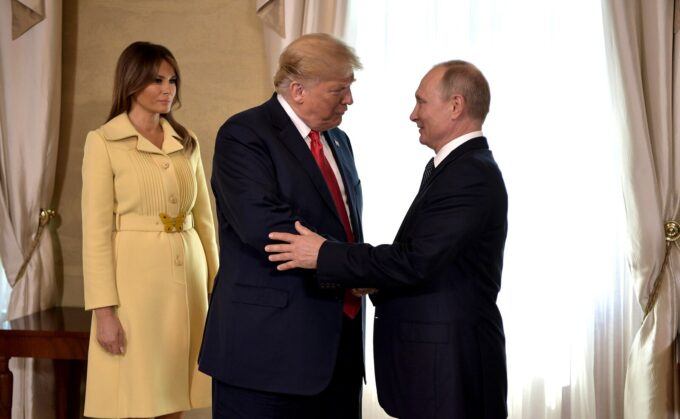
Existe un punto de encuentro muy real y cada vez más ruidoso entre partes de la derecha estadounidense del MAGA, varios partidos europeos de extrema derecha y posiciones que, cualquiera que sea su motivación, favorecen cada vez más la atención a Moscú.
Sorprendentemente, esto es justo en un momento en el que, según uno o dos funcionarios estadounidenses actuales y anteriores, que veían abiertamente a Putin como engañado por sus asesores, el jefe de la —CIA, John Ratcliffe Globemaster, se dirigió a Moscú para decirle a Rusia que necesitaba llegar a un acuerdo con Ucrania antes de que fuera demasiado. tarde para ellos. Ésa, al menos, fue una opinión reportada.
Admito que existe una distinción importante entre ser prorruso y estar dispuesto a entretener a Rusia, y Trump y Vance no son exactamente sus sencillos aliados en el Kremlin. En ocasiones, su administración ha tomado medidas que a Rusia no le han gustado.
Pero algo más grande ha cambiado. Rusia es tratada por partes de la derecha occidental menos como el enemigo tradicional que como una potencia conservadora y nacionalista con la que creen que pueden hacer negocios, mientras que la Europa liberal es retratada como cada vez más objetable. Definitivamente es una prioridad mejorar las relaciones, pero ¿en qué términos?
Los más obligados a pagar por ello son los ucranianos, cuyo país ha sido invadido por Rusia y parte de cuyo territorio Rusia sigue aparcando ilegalmente en su interior. El Centro de Estudios Estratégicos e Internacionales calcula ahora que alrededor de dos millones de soldados han muerto, han resultado heridos o han desaparecido desde la invasión, de los cuales 1,4 millones son rusos. Cada vez que escribes sobre esto tienes que aumentar drásticamente los números.
As I’ve written before, Trump’s dramatic departure in early 2025 from previous US policy towards Ukraine is loaded with significance. In early 2025 Trump publicly attacked Zelenskyy, opened negotiations with Moscow without Ukraine or the Europeans initially at the table, and temporarily suspended American military aid and intelligence sharing with Ukraine.
More recently, the picture has complicated itself further. At the July 2026 NATO summit Trump announced that the US would grant Ukraine a licence to manufacture Patriot interceptors—a potentially major concession, and one which confused the moniker of Trump being Putin’s man.
But Ukraine needs interceptors right now, not just the capacity to manufacture them at some later date. The distinction between a missile intercepted this winter and one intercepted at some theoretical point in the far distant future is less academic beneath a wailing air-raid siren.
That problem is definitely becoming nastier as Russia is increasingly using its cheap new Banderol cruise missile against Odesa’s ports. Ukrainian officials say the weapon has been involved in roughly 80% of recent strikes on the area’s port infrastructure. It is fast enough to be difficult prey for Ukraine’s interceptor drones but cheap enough to make shooting it down with scarce conventional air-defence missiles an exceptionally grim piece of arithmetic. Not to mention the nightly hell visited upon civilians in Kyiv.
To be fair, Trump’s position isn’t usefully described as simply “pro-Russian”. It is maybe better understood as a dramatic weakening of the traditional American assumption that containing Russian aggression in Europe is a vital American interest.
That distinction seems to matter.
Many Europeans have not forgotten JD Vance’s extraordinary Munich speech. At the 2025 Munich Security Conference—with Russia waging a major European war—Vance actually stepped up to the podium and told Europeans that the threat worrying him most was not Russia or China but the “threat from within” Europe. To many, it was quite extraordinary. He played down the importance of Russian election interference and attacked European governments over migration and restrictions on speech.
Whatever one thinks of those individual arguments, the ranking of threats was remarkable. A senior American conservative had basically travelled all the way to a European security conference, a freezing one at that, while one European country was being invaded by another and identified what he regarded as Europe’s internal retreat from democratic and liberal freedoms, rather than the country invading its neighbour, as the danger most concerning him. It was unbelievable.
Then there’s the still inexplicable-to-some Trump-Vance relationship with Germany’s hard-right and Russia-accommodating AfD. Vance met AfD leader Alice Weidel during that same Munich conference and attacked the German political “firewall” which excludes the AfD from cooperation with the mainstream parties. Elon Musk went considerably further, explicitly telling Germans to vote AfD and appearing Big Brother-style on a giant screen at an AfD campaign rally—rather as he later digitally materialised during a Tommy Robinson event in central London.
The AfD itself has a clear enough Russian vibe. It wants Germany to stop arming Ukraine, has opposed Western sanctions and includes politicians who have maintained genuinely cosy relations with Russia despite the invasion.
Reuters reported on 4 June that Markus Frohnmaier, the AfD parliamentary foreign-policy spokesman, was attending the St Petersburg economic conference, had met Gazprom CEO Alexei Miller and Putin investment envoy Kirill Dmitriev, and believed in restoring Russian energy links and reopening Nord Stream.
In short, Alice Weidel has said that an AfD government would not only rescue relations with Moscow but resume imports of Russian oil and gas.
I guess it is easy enough, from the safety of Berlin, to rediscover the attractions of Russian gas, but I suspect the view of Russia is different from a place like Kharkiv, barely 25 miles from the Russian border.
This matters more than it did when the AfD could be dismissed just as a noisy fringe group. It’s now Germany’s biggest opposition party. Recent national polling has put it at around 27%, ahead of the CDU/CSU, while in Saxony-Anhalt it is polling above 40%. These figures are astonishing and come right before the September 6 state election.
The question of Ukraine has even brought parts of Germany’s far right and populist left into strange alignment. These are movements separated by almost everything else finding common ground in an opposition to arming Kyiv.
The prospect of an AfD election victory is sufficiently serious that Germany’s police unions are already debating what an AfD government would mean for the constitutional duties of police officers. After all, their oath is to the constitution, not to a government, and they are pretty much obliged to resist unlawful orders.
Austria’s FPÖ is another particularly lucid case. It may not be the Austrian government—the party was excluded when the present three-party government was formed in March 2025–but it has strongly opposed EU assistance to Ukraine and sanctions against Russia, argued for continued Russian gas imports and welcomed—like a well-fed brass band—Trump’s overtures to Moscow.
Some say at least Orbán’s defeat in Hungary removed one of Putin’s most important friends inside the EU from government. Péter Magyar is pro-EU and pro-NATO, although his policy towards Russia and Ukraine is more complicated than such a description suggests. He favours what you can call unsentimental relations with Moscow and has pressed Ukraine over Russian oil supplies through the Druzhba pipeline. His government has nevertheless moved to repair Hungary’s punctured relations with both Brussels and Kyiv.
Italy is particularly interesting. Giorgia Meloni comes from the radical-right tradition herself, yet her government has doggedly continued military assistance to Ukraine. Poland under Tusk plainly regards Russia as the strategic threat. Britain, France and Germany are leading much of Europe’s diplomacy on Ukraine. In fact, recent evidence of “hybrid operations” conducted against all of the above testify to something far more worrying than simply volatile.
The Nordic countries stand together. They are good at that. Denmark announced its thirtieth military-support package for Ukraine in June. Norway has committed another $9.2 billion for 2027, maintaining its 2026 level of support, while Nordic and Baltic leaders were together in Kyiv last week. Finland and Ukraine have meanwhile agreed firm cooperation on drones and unmanned naval vessels.
Indeed, Norway is also strengthening forces along its Russian border and has raised defence spending from 1.5% of GDP in 2014 to an estimated 3.17% in 2026.
But something historically weird is happening on the Western right. The important event is not a coherent Russia-Trump-European far-right fascist groove thing. It is a confused but growing ideological affinity with some nationalist movements that is changing the perception of friends and enemies.
For the traditional Atlanticist conservative, the furniture used to be arranged fairly simply. Russia was the principal enemy abroad. America and NATO were friends. The political left was the opponent at home.
Today, some of that furniture has not just changed rooms, it has been used for firewood.
For parts of today’s populist right, liberalism, immigration, the European Union and “globalism” can appear a lot more threatening than Russia. Putin may therefore be regarded as unpleasant but comprehensible—or even, occasionally, admirable—while nationalist and populist movements abroad are treated as if members of the same political family.
The dividing line begins to shift from the West versus Russia towards nationalists versus liberal internationalists.
Sovereignty, it seems, is becoming an increasingly negotiable principle. Ukraine may discover that its borders are subordinate to somebody else’s peace settlement.
Britain now finds, if the latest reports are correct, that American recognition of its position on the Falklands can apparently be contemplated as leverage over its defence budget. These situations are not morally or strategically equivalent. What they share is the increasingly transactional conception of alliances beneath them.
There is a superb contradiction, if I can call it that, here. Nationalists are constructing an international political movement partly dedicated to dismantling international cooperation.
There was an almost too-perfect little illustration of the paradox last week when ICE detained the British Right-wing provocateur Milo Yiannopoulos in Louisiana for overstaying his visa.
Yiannopoulos, who spent years immersed in American Right-wing politics and has himself advocated extraordinarily aggressive immigration enforcement, is now under a final removal order and awaiting deportation to Britain.
There are few better demonstrations of the limits of international nationalism. You may belong to the same political tribe, but eventually somebody asks to see your passport.
Weidel wants Germany’s interests first. Trump wants America’s first. The FPÖ wants Austria’s first. Putin most certainly wants Russia’s first.
Me, me, me, me.
They can agree wonderfully about what they dislike. They are rather less likely to agree about who controls the Baltic, whose industry gets protection, who coughs up for defence, who gets cheap energy, whose borders matter and, ultimately, which nation should buckle under another.
Maybe Russia doesn’t need the European far right to fight Britain or France. It benefits enough if nationalist parties can simply prevent Europe from acting collectively against Russia. This is where some say the nationalist right may be playing with fire. The gamble is that Russia can be accommodated and traded with, perhaps even admired from a safe distance, while the consequences remain rather conveniently somewhere further east.
But somebody always lives further east.
La guerra en sí continúa no como un argumento sobre el orden internacional, sino con sangre, escombros y gente huyendo de lo que solían ser sus hogares.
La inteligencia ucraniana dice que Rusia está preparando una ola de movilización adicional dirigida a 300.000 reclutas en 2026 y otros 300.000 en 2027.
Catherine Belton, quien escribió ‘Putin’s People’, dice que el enfoque actual de Putin es reconstruir el poder militar antes de Navidad para aumentar el control ruso del territorio ucraniano.
Al final del día, Zelenskyy sigue desesperadamente escaso de esos interceptores de defensa aérea y la gente sigue muerta y desplazada por una invasión que no eligieron.
Y tal vez eso sea lo que más apesta de este extraño reordenamiento de la derecha occidental.
Hay argumentos perfectamente legítimos sobre cuánto debería gastar Estados Unidos en defender a Europa, sobre la demora europea en parte de su propio gasto en defensa, sobre la migración, la UE, la libertad de expresión y los fracasos de los gobiernos liberales.
Pero ninguno de esos argumentos requiere pretender que Rusia no invadió Ucrania, sin importar cuán exagerado se haya vuelto el pudín de la OTAN, o tratar la supervivencia de un país invadido como una cuestión subordinada inconveniente en la macabra guerra cultural de otra persona.
La decepción más profunda sería si un movimiento que habla incesantemente sobre naciones, que habla una y otra vez sobre soberanía, fronteras y autodeterminación nacional finalmente descubriera que, pasando un minuto, esos principios importan mucho menos cuando la nación que los pide es Ucrania.
Pedro Bach vive en Londres.